
Remembering David Hockney
Let’s look back at the groundbreaking artist’s career through five pivotal works.
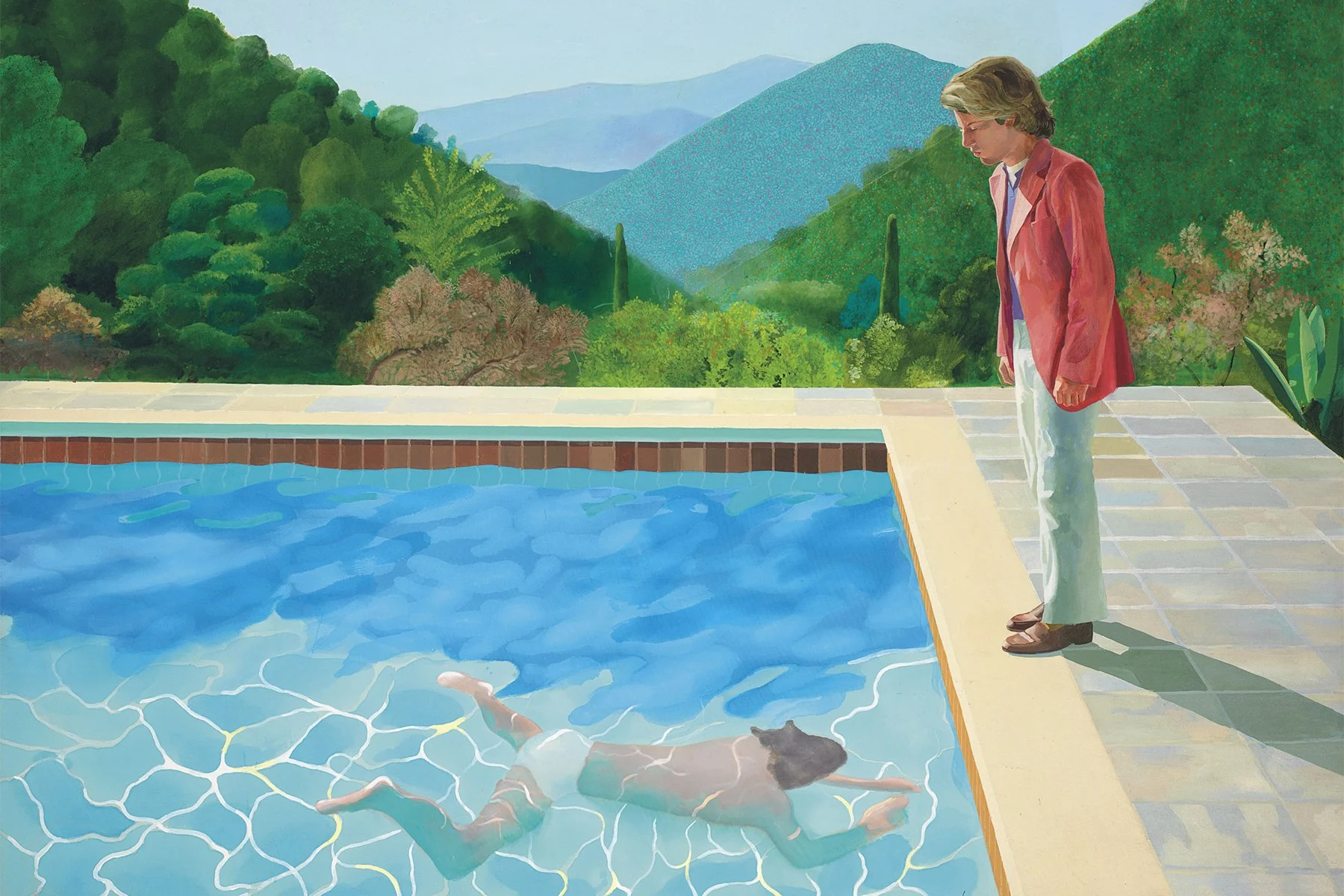
Cover photo: Portrait of an Artist (Pool with Two Figures), acrylic on canvas, by David Hockney (1972). Via Christie’s (cropped).
David Hockney’s Life & Passing
British artist David Hockney passed away in London on June 11, aged 88. He is remembered as one of the greatest artists of the 20th and 21st centuries. Hockney was appointed a Member of the Order of Merit by Queen Elizabeth II in 2012, and his painting Portrait of an Artist (Pool with Two Figures) set an auction record for a living artist in 2018.
Hockney is one of my favorite artists; I had the pleasure of seeing his work many times, including his 2017 retrospective at the Centre Pompidou in Paris. I especially adore his idyllic depictions of LA and vibrant renderings of Normandy. He was deeply sincere, unapologetically gay, and a passionate observer of the world. Let’s look back at five of the greatest works from his long and prolific career.
Adhesiveness (1960)
Hockney was creating openly homoerotic art at a time when homosexuality remained illegal in Britain. “I didn’t care about fitting in,” he later said. Throughout his career, he rendered gay life casually and naturally.
Many of Hockney’s early works were explicitly gay, including Adhesiveness (1960). The title refers to a phrenology term adopted by American poet Walt Whitman to describe intimate comradeship between men. Hockney depicts two figures in a sexual position, producing one of his earliest double portraits. He called it the “first really serious painting I’d done; it is my first painting to begin to have precision.”
Portrait of an Artist (Pool with Two Figures) (1972)
Hockney moved to Los Angeles in 1964, attracted by the city’s gay culture and luminous atmosphere. “I knew California was a sunny place with good light,” he recalled. He was especially fascinated by the challenge of depicting water. Swimming pools became one of his most iconic subjects, as seen in A Bigger Splash (1967).
Painted in 1972, Portrait of an Artist (Pool with Two Figures) presents an idyllic California landscape. The composition features Hockney’s former lover Peter Schlesinger gazing at an unidentified swimmer beneath the water’s surface. Although Schlesinger denied it was “a break-up picture,” the work evokes a quiet emotional distance.
The painting brought together many of Hockney’s signature motifs: the double portrait, the swimming pool, and the natural landscape. In 2018, it set a record at auction for a living artist, selling for $90.3 million. It was also parodied by the Netflix series BoJack Horseman (2014–20), a testament to Hockney’s global influence.
Walking in the Zen Garden at the Ryoanji Temple (1983)
Inspired by Cubism, Hockney pioneered photographic “joiners” during the 1980s. The technique was part of his pursuit of “reverse perspective,” a rejection of the static image presented by cameras. “Photography is all right if you don’t mind looking at the world from the point of view of a paralyzed Cyclops,” he famously remarked.
Kyoto’s Ryoanji Temple is renowned for its karesansui Zen rock garden. The garden contains a total of 15 stones arranged so that only 14 are visible from any single vantage point. During a visit in 1983, Hockney chose to record his walk around the space, tracing his footsteps across the wooden veranda through a series of photographs. By combining multiple viewpoints, he reveals all 15 stones at once, capturing an impossible reality.
The Four Seasons, Woldgate Woods (2010–11)
Hockney devoted his career to reflecting the complexity of human vision. “The eye is always moving; if it isn’t moving you are dead,” he argued. “The perspective alters according to the way I’m looking, so it’s constantly changing.”
In his groundbreaking digital installation The Four Seasons, Woldgate Woods (2010–11), Hockney employed 36 synchronized video screens, each with a unique vanishing point. The work depicts the changing seasons through four groups of nine video channels. Hockney joked, “Isn’t that three times better than 3D?”
Do Remember They Can’t Cancel the Spring (2020)
Hockney was an early adopter of new technologies and never stopped experimenting. Most famously, he embraced the Apple iPad shortly after its release in 2010, enthralled by its illuminated screen.
In 2019, Hockney settled in Normandy, France, where he continued working through COVID-19 lockdowns. Despite the uncertainty of the period, he focused on nature’s renewal. In 2020, he shared an image of blooming daffodils titled Do Remember They Can’t Cancel the Spring. The work offered a message of resilience and optimism, expressing Hockney’s joie de vivre.


