Ignacy Jan Paderewski: Polish Pianist and Patriot
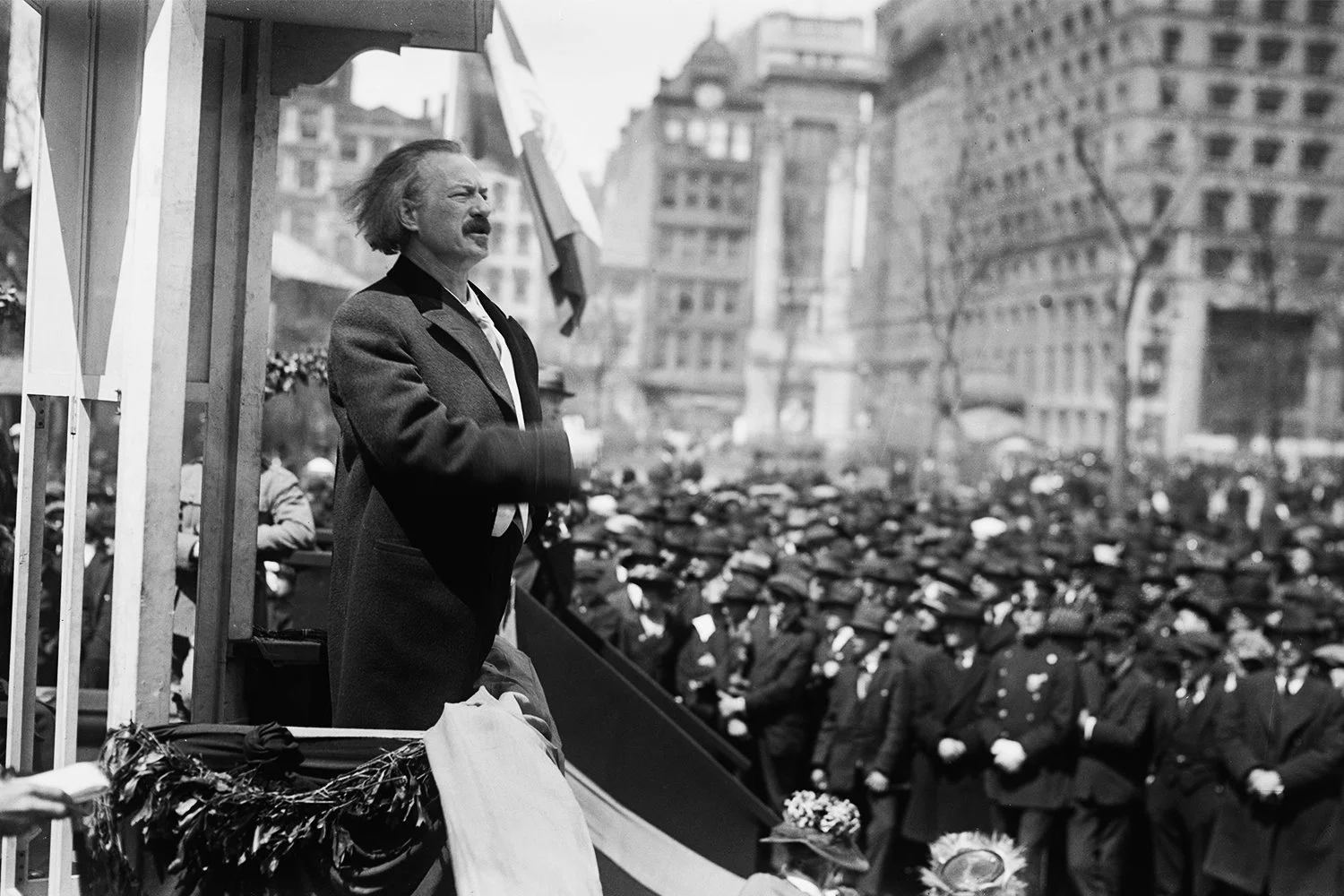
Paderewski turned his fame as a pianist into a force for Polish independence.
Cover photo: Ignacy Jan Paderewski speaks onstage at a public rally, United States (circa 1915-20). Photo by Bain News Service and via the U.S. Library of Congress (color-corrected and cropped).
Paderewski
Ignacy Jan Paderewski (1860-1941) was already an international celebrity when he first performed at Nashville’s Ryman Auditorium. But his influence would take him beyond the concert hall: he would use his fame as a musician to advocate for Polish independence. Today, Paderewski is remembered as one of the founding fathers of modern Poland, alongside leaders Józef Piłsudski and Roman Dmowski.
Paderewski the Pianist
Paderewski studied piano at the Warsaw Conservatory from the age of 12. At 27, he made his public debut in Vienna in 1887. He became an instant sensation, touring throughout Europe and the United States.
In 1891, Paderewski was the first performer to play solo at the newly built Carnegie Hall in New York. According to The Kennedy Center, he “was as wildly popular in his time as any of today’s rock stars.”
But Paderewski’s fame gave him something more valuable than a successful concert career: a global audience. He would use it to support the country that had been partitioned out of existence.
Paderewski the Patriot
In the words of British historian Richard Cavendish, Paderewski was “the world’s most famous Pole”. Paderewski leveraged his celebrity in support of Polish independence, conducting public rallies and fundraising.
He also helped strengthen the relationship between the United States and Poland. He met with President Woodrow Wilson and secured the mention of an “independent Polish State” in Wilson’s Fourteen Points, his postwar peace plan. Paderewski served as Prime Minister of the Second Polish Republic and as Foreign Minister, representing Poland at the Paris Peace Conference of 1919.
Paderewski retired from politics soon after signing the Treaty of Versailles, returning his focus to music. He lived in the United States but continued to support Poland through benefit concerts and other efforts.
American historian Eugene Kusielewicz concluded, “Indeed without Paderewski the cause of Poland might never have become the thirteenth of the fourteen war aims of one of America’s greatest presidents, and one of Poland’s foremost benefactors.”
Paderewski’s Legacy
Paderewski’s career is impossible to define by a single category. He was a virtuoso pianist who became a political leader, a celebrity who became a diplomat, and an artist who used his international platform in service of his homeland.
More than a century later, Paderewski offers an unusual example of how different skills can reinforce one another: the pianist and the patriot in one man. His ability to combine those roles helped make him one of the most distinctive figures in the struggle for Polish independence.
Combining Strengths
As a Polish-American, I’m especially drawn to Paderewski’s story because I see something familiar in his ability to bring different skills and experiences together. Today, I combine my international experience with graphic design and communications work at the Consulate-General of Japan in Nashville.
Paderewski’s example reminds me that we don’t necessarily have to choose between the different skills, interests and experiences that shape us. Sometimes, the most meaningful work comes from bringing them together — intentionally and creatively — and finding ways for one to strengthen the other.